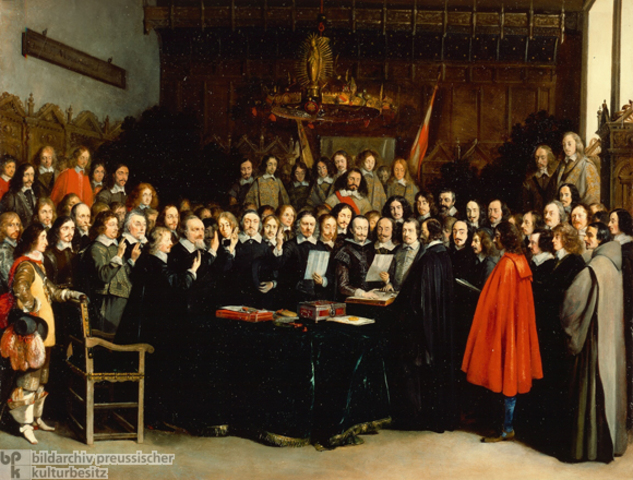
In a turbulent international system, the continuation of ingrained principles such as those laid down in Westphalia is a hard task to continue. Yet for the most part, this remains true. This essay will ascertain that the principles of Westphalia still mainly operate as the rule-setting agenda that underpins International Relations. Furthermore, as a homogenised unit the West generally and the anglosphere more specifically, have been successful at maintaining theoretical and empirical dominance over their counterparts due to historic and continued reciprocity between states that has gatekept the higher echelons of the international stage from adversaries. However, since the end of the Cold War the decline of American hegemony and their international power-breaking capabilities, has led to a marked shift in global power balancing from western circles to a more multi-polar composition. This up-ends the primacy of Westphalian actors and principles, inviting competition from other sources of global power. Primarily, International Relations theory with ‘Chinese Characteristics’ is rapidly challenging Westphalian, and by extension anglospheric models of engagement within and without international institutions. Yet this attempt is still in its infancy, and it remains to be seen which philosophical pole will emerge to assert or reassert international control.
The international system has existed for time immemorial in one form or another, led by ever-changing dynasties, empires and nation-states. However, to fully understand the impact that Westphalian principles have had upon the nature and character of the greater international order, the terms of debate must be set out. The peace of Westphalia is much agreed upon by historians to mark the creation of the origins of the modern international system. ‘Westphalia’ or the ‘Westphalian Order’ references the 1648 peace conference which is widely used to describe the longer process of state-building, democratisation and pluralisation that occurred before and after the conference, within European entities that then spread throughout the globe mostly in the form of empire and colonial expansion. Furthermore, it established a European (and now Western) rulebook which in large part dictated the course of European nation-state and empire building right up until the modern day. International order is defined succinctly by Lascurettes & Poznansky as entailing “…some level of regularity, predictability, and stability in the ways that actors interact with one another”. Finally, the question concerns the current balance of power, which essentially describes the battle between vying (cliques of) nation-states that attempt to dominate or at least heavily influence international politics. This essay will contend with these complex concepts and come to a supported judgement of the current state of the westphalian impact upon international power structures.
The Westphalian Order
Since 1648, the Westphalian conference has had a tremendous impact upon the nature and character of the international order. The Westphalian peace process formalised two core tenants of International Relations theory that underpin all international institutions today; state sovereignty and legal equality. In the context of constant warring between European entities, these principles enshrined norms of legal superiority in one’s own territory, with a policy of non-interference into another authorities’ domestic affairs, which find their philosophical roots in Realism. The impact of these is apparent in the modern world, as set out in Article 2 of the UN charter which enshrines the principles of equal sovereignty and non-intervention. Both these conceptual giants were the pillar stones of the original European ‘Standard of Civilisation’ which, based upon shared norms and values, has gone on to act as the benchmark for entry into international society for all state-like entities across the globe.
These creations of 17th Century Europe still exist today as the primary barriers of International Relations, when dictating institutional relationships generally, yet particularly between western and non-western states. In major organisations Westphalian states often hold majorities within decision-making entities, such as the UN Security Council where three of the five permanent members are western nations (US, UK & France) as set out in the UN charter (Article 23). As well as setting the basis of institutional arrangements from a theoretical perspective, formal power relations are maintained as the westphalian-led western states dominate the initial creation, agenda-setting and decision-making aspects, which allow them to continue to pursue their own strategic goals. With this in mind, and the contemporary definition of ‘International Order’ we can clearly see that Westphalian principles and Westphalian-inspired states continue to define the International Order internally, yet also hold significant sway through unilateral action.
Anglospheric Unity
Westphalian principles have not only survived purely upon their inclusion in the makeup of western states and international organisations, rather their very existence today is predicated on their mutual maintenance by the anglosphere (US, UK, AUS, NZ, CAN). Specifically the reciprocal relations between the parties within and moreover, without international organisations as the main arbiter of international relations. Indeed, this can be seen through a variety of unilateral agreements, as well as more collaborative arrangements. For example, the recent AUKUS alliance, which as a military-industrial pact circumvents traditional institutions in favour of traditional allyship. The western partners engaged in trilateral action to extend and deepen militaristic ties in the Indo-Pacific region by providing Australia with nuclear capabilities. These recent developments continue the long history of reciprocity between anglo-saxon states, continuing an elite clique of states which hold considerable similarities due to the shared colonial history they all possess.
These states, who all maintained westphalian state relation principles, played a considerable role in the creation of international law which deeply underpins the International Order (within and without international organisations). Drawing on the Westphalian state system, 19th century European states (particularly Britain) developed the notion of the ‘Standard of Civilisation’ based on European cultural norms, values and practices as the entry requirements to fully access international society and thereby shape the order. Bowden posits that “Any nation that did not meet the prerequisites for membership in European international society – which was much, if not most of the non-European world – was, by definition, ʻuncivilizedʼ”. Therefore by extension, these states were inferior to European ones. Williams goes on to further explain that this colonial creation was “…sustained by a central idea: the Westʼs religion, civilization, and knowledge are superior… This superiority, in turn, is the redemptive source of the Westʼs presumed mandate to impose its vision of truth on non-Western peoples.”. These findings have considerable explanatory power when discussing the foundations of the International Order during the 19th-20th Centuries, as these theories of superiority were ingrained in the DNA of international institutions, and therefore add reason as to why western states still remain in premier positions, such as in the UN as discussed previously, and therefore why the international order retains its Westphalian character.
The Sinosphere
However, these defining characteristics are being manipulated and changing due to the increased involvement within the international arena by a plethora of rising states that do not conform to western methodologies, but rather pursue their very own versions of International Relations. Particularly China, in the last 30 years has become more assertive within international institutions after learning the Westphalian rules of engagement. The development of International Relations with ‘Chinese Characteristics’ is in conjunction with China’s drive into positions of power and responsibility to begin to shape the globe to their own strategic objectives. As Kim states “Scholars who have closely studied IR discipline in China agree that there is a close link between the country’s academia and its policy circles.” Therefore showing the drive towards creating new scholarly models of IR which can be translated into policy choices.
Additionally as with the foundation of Westphalian models of International Relations, Kim finds that “…many Chinese scholars base their theory on ancient or modern Chinese history…” Indeed, China has a rich history to draw upon for the creation of their own IR scholarship, particularly in direct competition with Westphalian principles is the Chinese Tributary system which existed from as early as the 7th Century. These developments are revitalising the oft-associated ‘Confucian World Order’ which poses as a direct competitor to Western-led circles, and as China grows in assertiveness, is slowly changing the character of the current, and defining the future International Order. This is directly demonstrated by the Chinese-Russian tactical alignment in the U.N. Security Council which in July 2020 vetoed two resolutions regarding Syria and blocked the appointment of a French national as special envoy for Sudan. Although not fully formed, the growth in both Chinese scholarship and regional policy development is an indicator of future Eastern dominance of the International system.
Conclusion
In conclusion, this essay has demonstrated the historical backdrop on which European principles and the Westphalian state system were founded within, how they developed through the drive to expand and thereafter colonise the globe. This accelerated globalisation and created the initial modern International Order, which underpinned all International Relations within and without global institutions. This has maintained agenda-setting power for the west, as well as the continued reciprocity between anglo-speaking states. However whilst it remains intact, this status quo is being more intensely challenged by different sources of International Relations scholarship. Specifically Chinese, which poses the most real and direct threat to Western and US-led hegemony in the international arena. In my view, as US dominance continues to decline, the leadership-vacuum left is and will continue to be filled by a China driven to model the globe in its image after centuries of Western dominion.
Bibliography
- Brown, Chris. Understanding International Relations. (Basingstoke, Palgrave, 2001)
- Charter of the United Nations. (2012). Available at: https://www.un.org/en/about-us/un-charter (Accessed 10th January 2022).
- Lascurettes, Kyle M. and Poznansky, Michael. International Order in Theory and Practice. (Oxford, University Press, 2021).
- Brett Bowden. The Colonial Origins of International Law. European Expansion and the Classical Standard of Civilisation. (Heidelberg, Journal of the History of International Law, 2005).
- Robert A. Williams Jr. The American Indian in Western Legal Thought: The Discourses of Conquest. (New York, Oxford University Press, 1990).
- Hun Joon Kim. Will IR Theory with Chinese Characteristics be a Powerful Alternative? (Oxford, The Chinese Journal of International Politics, 2016).
- Jeffrey Feltman. “China’s expanding influence at the United Nations – and how the United States should react.” Brookings, Sept, 2020.
 Politica Carnivora