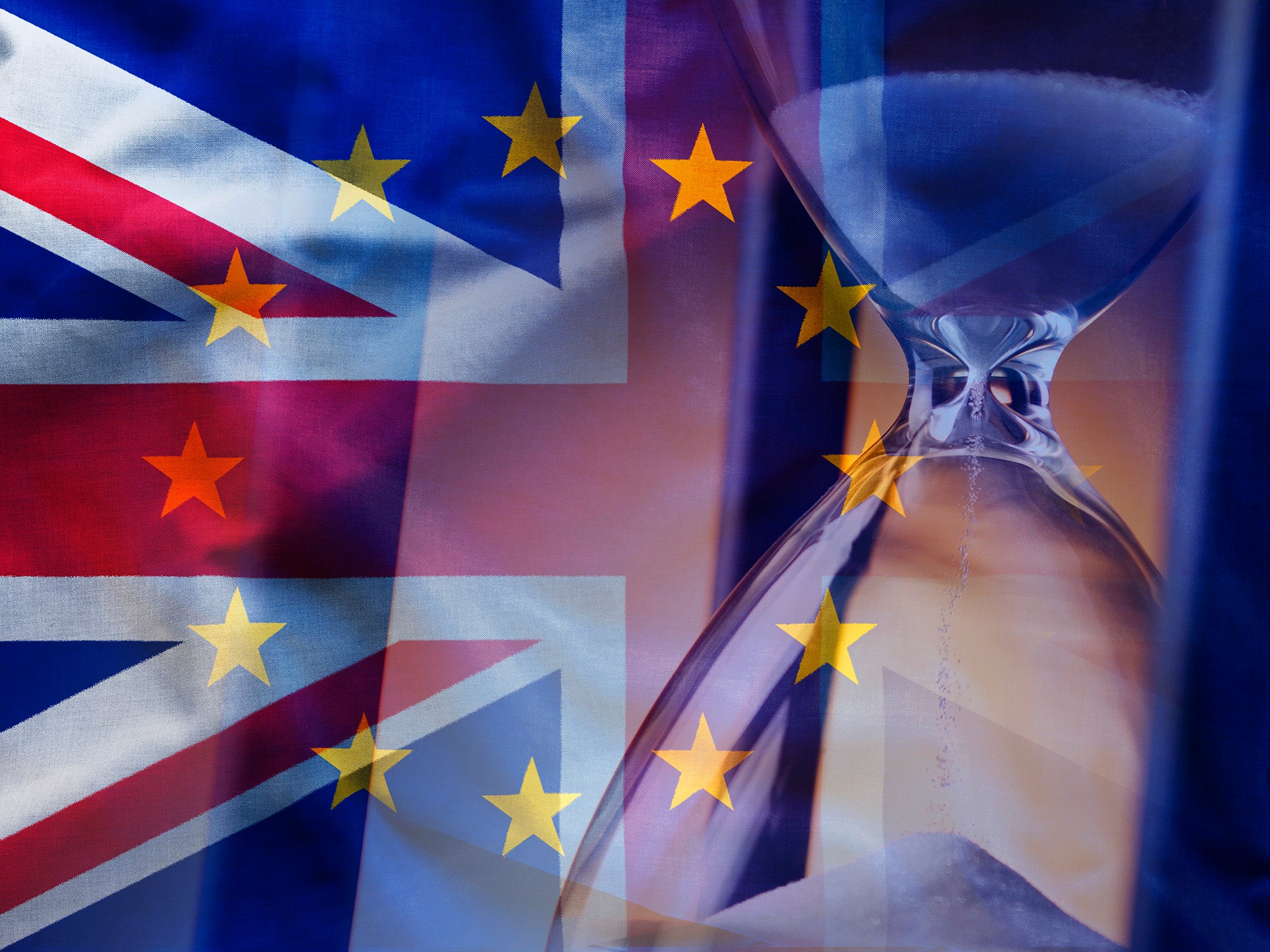
Broken Britain: How Brexit highlighted the gaping holes in British democracy.

Retrieved from: http://www.independent.co.uk

A historically flawed electoral system, an unrestricted rightwing politico-media complex and lying politicians were the fundamental causes of Brexit; and they still exist as the fundamental cancers attached to British democracy today. A radical update of the political system is urgently needed. In this article I’ll touch on what went wrong, how we can ensure all political persuasions are adequately represented in future, and how a more secure democratic connection can be made between people and politics.

Two-party states are dead men walking.

Britain. The home of parliament, said to be the most democratic form of government when it was conceived in 1215, and when developed over the following centuries to what we have today. First Past the Post (FPTP) was the system chosen, with each constituencies MP being selected to stand in parliament based on the most amount of votes being accumulated. Simple and effective right?

To some; yes. Yet what about the losers in a winner-takes-all race? Since its creation, parliament has been a heavily dichotomous institution. From Whigs and Tories to Labour and the Conservatives, governing and the governed have been the only two categories available to political parties. When coming to such an impasse as Brexit, which has historically divided the country, what did our officials decide to do? Put it to the people of course. Yet nothing was done to ensure all potential views of European Union membership were made clear to the electorate. Britain’s leaders gave two choices; yes or no. Black or White; reflecting the long-held tradition of Parliament. Yet as anything in life, we know the grey zone in-between two poles is where the majority lies. In a decision that affected everyone holistically, we were divided into tribal camps, and told to prepare for political warfare.

To give two options to a question that has a thousand answers, could we really expect the result to be respected? The idea of a united Europe to varying degrees politically, economically, socially and militarily has so many complex components that one question could simply not do any justice to the position we found ourselves in as Europeans in the 2000s prior to 2016. Europe had been moving in a collective direction since the fall of the Soviet Union, and it seemed that the prowess of the continent could have grown to rival that of the American hegemony or the Chinese state, unseen since prior to the Second World War. Yet Britons were unhappy, and had been distrusting of their mainland counterparts, in part for fear of creating something greater than Britain alone. This nationalistic vision of Britain and her Empire still twinkled in the eyes of many, many who felt that the present had not been kind to a sovereign land that led Europe for centuries in times past.

However, this information is not unknown, European integration has had many interpretations since the UK first joined the European Communities in 1973, and has been championed and despised by left, right and centre. So why, with prior knowledge of this, were we led to a stance of stay and remain or leave and lose it all? Indeed, stay or leave what? Do we wish to retain more political independence from European directives? Do we wish to revoke our customs union and market access for frictionless trade and travel? If yes, how MUCH of these institutions do we reject? 50%? 75%? The question itself only really creates more questions, and little in the way of answers. So how were we ever supposed to address the issue from all its angles with a one word reply?

Fundamentally, the British political system has always prioritised simplicity and limited interaction between parliament and people, over full democratic oversight and input by the demos. To bring my point full circle, it did not matter that Brexit was the issue, systems are designed to cope with problems and produce a solution. Yet Britain it seems was designed to take problems and create more problems. The idea that any issue can be solved by providing only two possible solutions is terribly unpragmatic among many other things. So to side with 52% over 48% in an issue where so many individual sects exist (indeed in an environment where rational perspectives were hard to come by, and disinformation was being served up on the side of buses with promises of everything) was bound to fuel the fire of division and leave more displeased with the outcome than pleased; on both sides of the table.

Yet the only thing that has united Britons from Brexit until now is the idea that change is LONG overdue. Be it in or out of Europe, the people of this land know that ‘business as usual’ is no longer an option. People are unhappy when unheard, and when only two majority voices are allowed airtime, that unhappiness turns to anger and hate. Business as usual will continue if the two same CEOs remain in the conference room. So when many new and differing views cannot be expressed by the old two, is the rational solution not to open the door to fresh faces? No longer can we accept that the existing speakers for the people ‘may’ advocate a view that ‘might’ co-inside with what we believe in. For such a diverse populous such as Britain’s, an equally diversified form of political representation is needed.

Until this idea reaches the decision-making arena of British politics, or until it is forced by a popular revolution, the dead will walk on. Yet this does not change the fact that they are still dead men on the way to the grave, and whilst they still step, we the people can decide the way in which we want our future to be decided.

Proportional Representation for the Nation

Retrieved from: https://www.involve.org.uk/resources/methods/citizens-assembly

The most practical and non-sensical way to provide proper representation to a country where many feel marginalised is through proportional representation (PR). The simple idea of proportionality is that the number of votes cast as a percentage for a particular party reflect the percentage of seats won by that same party in parliament. In the current FPTP system for example, many hundreds of thousands of votes are rendered pointless as they are cast in the wrong constituency, where the opposing party has a strong vote share based on the majority demographic. Therefore election after election, generation after generation those that do not select the incumbent MP as their candidate, go unrepresented for yet another 5 year term. However, these people are still of equal value as voters, and for too long we have thought of them as sore losers; if the entire game is set up against you, how could you not be?

Indeed, once this view is reached, the next question arises; what form of PR do we decide to use? And will it actually enhance representation? Like Brexit, this question has a multitude of answers, but to keep it simple I will outline which system I would select, and what to amend to counter any major disadvantages. To make clear, some forms of PR include FPTP as a component of the overall system to ensure ‘strong mandates’ and a connection between constituent and MP. I do not buy into these. To include the old system in a ‘new’ system is completely self-defeating and piecemeal. Therefore, if you like, a ‘clean’ version of PR would be my preference.

To represent Britain, look to Europe

Retrieved from: https://europeelects.eu/ep2019/

It seems a little odd to say since we have now formally exited from the European Union, but our best option is to steal back the mainland’s form of voting during European Parliament Elections. The ‘Party List’ PR system is best explained by the Electoral Reform Society;

“Rather than electing one person per area, in Party List systems each area is bigger and elects a group of MPs that closely reflect the way the area voted. At the moment we have 650 constituencies, each electing 1 Member of Parliament (MP); under a Party List system we might have 26 constituencies each electing 25 MPs.”

Indeed, the system is well-proven, being used in over 80 different countries in different capacities as well as the EU. Party Lists simplify the political choice for the average citizen; find a party you agree with and vote. That vote goes towards the total party vote for a particular region, and will be reflected accurately in the number of seats attributed. This increase in constituency sizes allows as many votes as possible to have real effects, tearing down the smaller constituency boundaries which has led to the concept of ‘safe seats’ in today’s party politics. Therefore, all seats in any region are always up for grabs if the current MPs do not fulfil their promises made at the last election cycle. This change is highly understated in mainstream commentary, as it fundamentally does not allow parties to become lazy in what they offer their constituents, even if they had been favoured at the previous election. It also means that parties will have to go the extra mile if they wish to gain more seats in a locale, thus creating more ‘undecided voters’ in the build up to elections. Many would see indecision as weakness, yet I see it as a strength; to the people. The idea that parties really do have to ‘win’ voters is in full effect in this instance, and reduces the tribalist divide into sides, which is what has left us so primitive politically in how we discuss, debate and decide our collective future.

When choosing which candidates to field, I believe that parties know their members best. Therefore it makes sense to use a closed or semi-open form of candidate selection, meaning voters still vote for parties, but it is those parties that decide whom should stand where. At this point some may begin to criticise the Party List system for not being able to form a real connection between MP and constituent. Yet a particular amendment for this issue would be to mandate candidate selection based on local connection (i.e not sending southerners to the north and vice versa) or specific knowledge of issues that are of upmost importance to an area (social mobility, housing, environmental protection, etc). Furthermore if one wishes to speak to a specific MP either by party or province, each area must have quick and easy forms of communication, from emails to videocalls so constituents can schedule meetings to discuss local queries.

In this, I also believe the increasing importance of Citizens Assemblies cannot be disregarded. Citizen participation in politics goes hand-in-hand with proportional voting. Like jury service, call ups can be random and bring together a group that make up the true diverse dynamic of modern Britain. From race, religion, sexual orientation to political views and economic situation. Every voice is of equal value, with dissenting speech even more so. To truly provide a mandate for government, ALL of the UK needs to be informed and asked. Whilst also helping to solve our problems, these institutional settings can also aid our learning about people that may even live 5 minutes away, that have radically different views, personalities and interests to our own. This exposure to difference, can in its own way help to increase general understanding of who we are as a nation.

This lends to my final point about coalitions. FPTP’s defining characteristic is ‘strong and stable’ governance. Yet if you look at recent history that has been far from the truth. In reality it provides the victorious party with enough room to enact policies at will, even if they are harmful to us as people. So to think that coalitions would in some way worsen this situation is delusional. Coalitions allow no one to fully stretch their wings. This can be both good and bad, depending on who you politically support and who is in power at any given moment. However this is a contradictory belief, if only your party is allowed to do everything they wish to, yet when the opposition are in play they are wrong for doing so. Therefore although coalition means compromise, it also means more of the country at large are in rooms where policy decisions are made, destroyed and re-imagined. Is this not truer democracy? To put more of the people in power? Where we are all allowed to talk, we will find that we hold more similarities than differences, and can find common ground for a common good.

Everything may never be perfect in this life, but if we allow everyone to say their piece, we can at least provide more people with their own peace.
Without Socio-Economic Justice, Racial Justice is impossible.

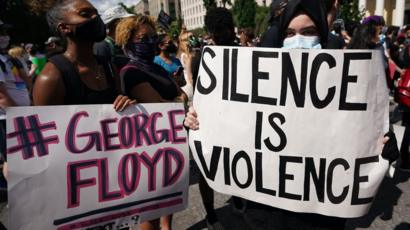
Silence is violence; but capitalism is judge, jury and executioner. Source: http://www.bbc.co.uk

There can be no racial justice without socio-economic justice. This is a known reality for all socialists in the world today. Martin knew this. Malcolm knew this. They professed as such. However for many, these concepts seem rather abstract and undefined, leading to the inability to make the important connection between the two. Here I will, from my perspective, explain why socio-economic (read class) injustice is directly linked to the racial injustice faced by millions of minorities across the world. Indeed, another important aspect to remember is that discrimination can occur between any two races. Indeed black-white race relations have been at the fore of the western mind when it comes to racism, but remember this is a stand for ALL that face racial discrimination, anywhere in the world.

The disproportionate impact upon working class minority communities

Throughout history, and the growth of the ever more cut-throat capitalist world we exist within, workers have had to deal with less and less and less. Wages in the western world have not risen in line with productivity since 1981. That means the increases in worker efficiency have been taken for granted; FOR 39 YEARS. Yet when we protest this and many other overt injustices, what are we met with? Police intimidation, abuse and murder. These characteristics do not change across country, they are the one commonality.

Yet, this injustice is hugely intensified when institutional racial biases are accounted for. America is currently under the spotlight, and is a place of obvious extremes, so it makes sense to outline my argument with the use of American examples. Indeed, working class African-American’s are the MOST targeted community in the US. On a basic level, African-Americans suffer from the double-effect of unregulated capitalism; poor working conditions, rights and pay, coupled with the implicit and explicit racism suffered at the hands of white customers, co-workers and bourgeoisie management.

This double effect is rife throughout the American Capitalist State. Beginning during the Civil War and Reconstruction periods, African-American communities have been systematically economically deprived (both in terms of governmental and commercial funding), due to the racial biases of majority white political, social and economic organisations (Small town right the way to the federal level). These racially-motivated officials have, and continue to promote, a policy line which dis-proportionally aims to uneducate, defund, and hold black communities hostage to their reality.

This is clear from studying the differences in financial support given to majority black schools and colleges versus their white counterparts today. In 2019, The Pacific Standard reported that ‘non-white school districts get $23 Billion less than white ones’. In the report, it found on a per-student basis, non-white concentrated schools received $2,226 less than white concentrated schools. This bias plays out as bad within commercial markets too; Forbes reported in 2018 that ‘ Black Home Buyers Denied Mortgages More Than Twice As Often As Whites’. The report finds denial rates (% of applicants denied loans) for White Americans were just 8.1% in 2016. Alternatively, in the same year denial rates were 21% for African-American’s – down from 34.3% at the time of the financial crash. Let that sink in. 1/3 of all African-Americans applying, were denied a conventional loan in 2007. Let me ask you; who owns the vast majority of banks? Who literally destabilised the economy in the pursuit of gross amounts of wealth, and then when it didn’t work got bailed out by the public purse? The White Upper Class. The exact same class that was there in 1929 at the helm, knowing that millions of workers, especially African-American workers, would be unable to feed their families, relying on federal scraps to survive the Great Depression, for almost a decade (because remember that same White Upper Class controlling the banks? Yeah they’re in government too).

Although I have barely scratched the surface, these examples are very telling for the position large majorities of African-American’s find themselves within. Underfunded as children, sent to rotting school facilities, with bare minimum supplies, in school institutions that literally target young African-Americans from pre-school all the way to High School. The US Department of Education released damning figures in 2014, which found that when black students and white students commit similar infractions at school, black students are suspended and expelled three times more often than white students. The US school system has embodied the ‘school-to-prison pipeline’ with law enforcement so often being called into schools to deal with altercations, that overly result in the arrest of young African-Americans on school grounds.

Without education, very little can be done to improve the financial position of so many African-Americans, and when applied on a national, and generational basis, it is evident that the cycle of poverty among the African-American working class continues. Therefore, when you have no ability to better life for yourself, under a system that wants to turn you into a modern-day slave within the prison-industrial complex, there can be little hope for any form of mass upward class mobility, and such the promise of a full life. This is the reality faced by millions of working class minorities across the world. Everyday.

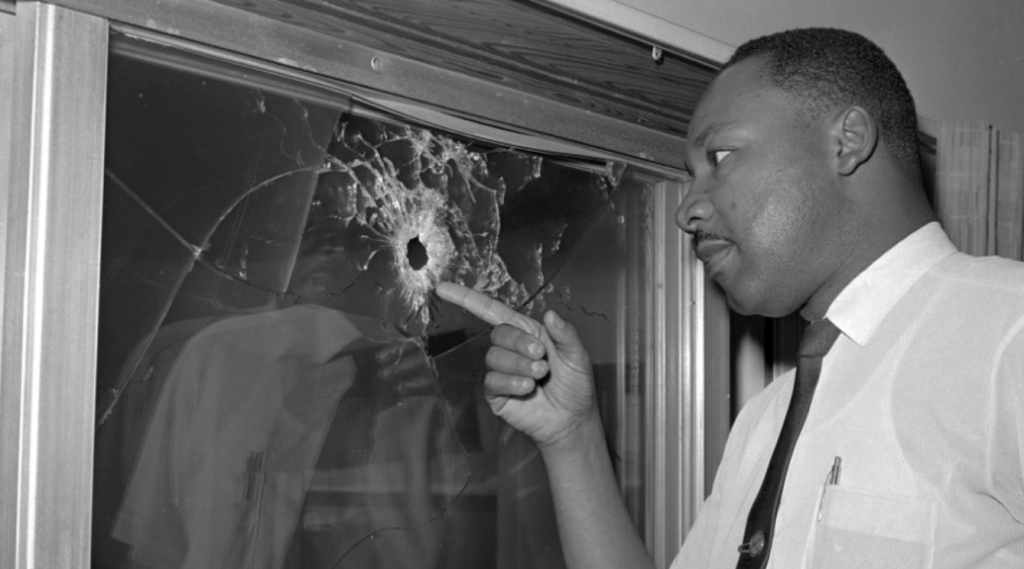
King laid out the triple header in the ills of America; Militarism, Racism and Capitalism. Here, King looks at a glass door of his rented beach cottage in St. Augustine, Fla. that was shot into by someone unknown on June 5, 1964. | Jim Kerlin / AP

It is important to remember however that these socio-economic issues and potential solutions were discussed by both MLK and Malcolm X during the 50s/60s. Although Dr. King came from a middle class family, and Malcolm from a working class one, both revolutionaries understood the importance of financial independence and security for African-American communities. Malcolm was more radical in the idea of an entirely separate, self-sufficient economy, and actually favoured a more libertarian capitalist model (within this African-American only community).

Yet, Dr. King knew and sympathised with the plight of the working class. He felt a strong desire to serve humanity, in particular the disinherited he had first seen standing in bread lines during the Great Depression as a child. Indeed, whilst on summer breaks from Moorehouse college as a teenager, Dr. King chose to work as a manual labourer, to understand the humiliation and suffering of the African-American blue collar worker. It was also known that King read Marx, considering his analysis of Capitalism on point. Why do you think then that in the months and weeks before his death on April 4th 1968, Dr. King was organising the ‘Poor People’s Campaign’? Aiming to bring together the poor, working class across America, from all different races to erect a tent-city in DC? To jar the conscious of a nation, to wake them up to the fact that American capitalism was deeply broken; and therefore required radical change.

Dr. King was a Democratic Socialist. There are too many of Dr. King’s quotes to include them all, but I feel this one summarises his exact beliefs; “I imagine you already know that I am much more socialistic in my economic theory than capitalistic… [Capitalism] started out with a noble and high motive… but like most human systems it fell victim to the very thing it was revolting against. So today, capitalism has out-lived its usefulness.” – A letter to Coretta, July 18th 1952.

Take on Dr. King’s challenge

As we come to a close, I feel it is important to remind people that Dr. King was a true socialist revolutionary. Morally challenging the very foundations of the American system, proposing a new model, which fundamentally was in opposition to those in power. In his honour, and the honour of so many of our fallen brothers and sisters whom died at the hands of those that hated them just for the colour of their skin, let us unite and finish what was started long ago. WE NEED RADICAL CHANGE. WE NEED RACIAL EQUALITY. WE NEED DEMOCRATIC SOCIALISM.

There is no racial justice without socio-economic justice.

Mentions

I want to thank my good friend Alex Edwards for his help in guiding me in the contents of this piece, your wisdom is insurmountable Grandad. I’m sure we’ll work together much more in the future.

Here are all the links to the sources I used (some are hyperlinked others not);

https://www.questia.com/magazine/1G1-13767790/martin-luther-king-jr-and-malcolm-x-economic-insights

https://en.wikipedia.org/wiki/Disenfranchisement_after_the_Reconstruction_Era

https://psmag.com/education/nonwhite-school-districts-get-23-billion-less-funding-than-white-ones

https://www.forbes.com/sites/alyyale/2018/05/07/mortgage-loan-denials-more-common-with-minorities-new-report-shows/

https://www.benjerry.com/whats-new/2017/11/systemic-racism-education

https://en.wikipedia.org/wiki/Poor_People%27s_Campaign

Context is everything; Descriptive Representation in Advanced Western Democratic States, and the call for the extension to the rest of the world.

Source: https://www.migrationpolicycentre.eu

Year 1, Block 4, Introduction to Political Science. Please contact me if you would like the source articles!

Introduction

Descriptive Representation is the idea that minority communities’ political representatives should reflect the mainstream experiences of that community in their own background. Yet does this improve overall representation of minorities within the mainstream political system? Mansbridge in ‘Should Blacks represent Blacks and Women Represent Women? A contingent Yes.’, Pantoja & Segura in ‘Does Ethnicity Matter? Descriptive Representation in Legislatures and Political Alienation Among Latinos.’ and Bird in ‘The Political Representation of visible minorities in electoral Democracies: A comparison of France, Denmark and Canada’ all tackle the topic of minority representation. Whilst Mansbridge contends that Descriptive Representation brings a net benefit to a given polity, Pantoja & Segura find that the existence of a co-ethnic representative is a necessary but not sufficient condition for the improvement of ethnic representation. Bird’s concludes that institutional arrangements, particularly the configuration of party mechanisms, are the most influential factors which determine the level of ethnic representation. In my view, the three articles in tandem provide a strong conceptual base in understanding Descriptive Representation, and accurately access the viability of its implementation, whilst also providing complementary theoretical perspectives and empirical evidence. Yet this contextual evidence is still limited, and so the study as a whole would benefit from more cross-polity and intra-polity studies, as well as updating the theory with modern considerations.

Summary

Motivated by the inability of previous research to pass dichotomous thinking, Mansbridge  outlines from a normative theoretical perspective why the implementation of Descriptive Representation for disadvantaged groups within a given polity would bring net benefits for the wider political system. She outlines which contexts and for which functions Descriptive Representation can operate within, and asserts that if institutionalised in a fluid manner, it can ultimately be a highly useful tool for improving the quality of overall democracy. Particularly improving the aggregative and deliberative functions. Yet, Mansbridge stresses the importance of context; using it to weigh up the costs and benefits of utilising particular forms of Descriptive Representation. Comparatively, Bird was provoked to write her article after directly citing gaps in previous research (such as Mansbridge’s), which she contends has not focused on the interplay of institutions and minority community organising structures. Moreover, they over essentialised minority groups, whom upon closer inspection are not all equally underrepresented. Bird writes her article in the hope to develop a conceptual framework of factors influencing the political opportunity structures within a given polity that effect visible minorities access to the political system and office. She takes a more qualitative approach with single depth studies of advanced democratic polities, with a more institutionalist orientation. She argues that the degree of openness of the political system, party processes of candidate selection and electoral rules are the most critical factors in influencing her ‘opportunity structures’. However, the interplay of these is not universal, which Bird qualifies in the differences identified between her case studies, which all have different level of autonomous organising capabilities within minority communities. Finally, Pantoja & Segura were motivated to write their article by the lack of studies surrounding the Latino experience of Political Alienation, with the goal to see if one form of political alienation; normlessness, was felt by Latino’s to different levels based on whether they were co-ethnically represented at atleast one or more legislative level. Pantoja & Segura take a positivist approach to their methodology, focusing on quantitative statistical modelling to provide them with the data from which to create inferences. They find overall that, outside of smaller misgivings, their main conclusion is logically supported by their findings; that co-ethnic representation is more desirable than none to most Latino’s, yet it was not overtly endorsed by all. Whilst finding that Descriptive Representation is not sufficient on its own to instantly address the interests of minority groups, Pantoja & Segura consider it a necessary part of a wider strategy to improve the quality of representation and thus the connection between citizen and state.

Analysis

Indeed, all three research groups have differing focuses of their pieces, which heavily influence the theoretical and methodological approaches taken. Mansbridge primarily focuses on advancing her more optimistic view of the power of Descriptive Representation, and how it can be properly integrated into democracy to improve representation. This leads Mansbridge to take an idealistic tone within her normative approach, marking the conceptual bounds of Descriptive Representation in what it is, how it operates, in which contexts and for which reasons it should operate (1999, p. 628). In essence Mansbridge provides a uniform conceptualisation and conceptual application of Descriptive Representation. Alternatively, Pantoja & Segura’s focus upon Descriptive Representation is less for the promotion and explanation of the concept, and more directly for assessing its impact in specifically alleviating American Latinos feelings of political alienation through normlessness within California and Texas (2003, p. 441) This direct focus leads Pantoja & Segura to take a smaller-scale angle, and utilise a more positivist and analytical approach which emphasises descriptive quantitative modelling in order to provide insights into the size of Descriptive Representation’s impact on Latino views of government in the US. Finally, Bird’s focus is along similar lines to that of Pantoja & Segura in that it is more of an assessment, yet focuses less on the behavioural responses of a particular minority group. Instead, Bird’s focus lies in identifying which institutional level of governance is the most influential in affecting minority candidates ability to entering legislative office (2005, p. 425). To illustrate better the prevalence of such level, Bird uses qualitative methods of single depth studies into multiple polity’s in order to compare and find commonalities across systemic lines, highlighting which democratic mechanisms are closest tied to the ‘Political Opportunity Structures’ that exist (p. 429).

Despite this difference in methodology, all of the texts emphasize the importance of context when understanding the substantive power of Descriptive Representation. Indeed, most explicitly, Mansbridge does this by identifying “…group mistrust, uncrystallised interests, a history suggesting an inability to rule and low de facto legitimacy…” as defining the contextual boundaries for Descriptive Representation (1999, p. 628). Mansbridge spends considerable time in explanation of these different contexts within the text and the choices presented within each, as well as the risks and benefits to institutional designers. It is therefore no surprise in her concluding remarks, that Mansbridge ascertains that the best understanding of Descriptive Representation is contextual, when the benefits are most likely to outweigh the costs (p. 654). Pantoja & Segura also provide this similar verdict through the results of their research. Indeed, they contend that the power of co-ethnic representatives to improve trust in government must be viewed in the context of the interplay of all present factors. Empirically, Pantoja & Segura find that the statistical strength of Descriptive Representation is minor, and overall was second to many other factors. They explain that past this initial agreement, co-ethnic representation was not the most influential tool in reducing alienated responses. Latino Representative Power, Internal Efficacy, Spanish Media, Age and living in Texas all had higher mitigating effects (Pantoja & Segura, 2003 p. 450). This finding was qualified by their inclusion of Hero & Tolbert, who in their own testing during 1995, found that little evidence existed for the connection between Latino descriptive representation and substantive representation (p. 456), which has evidently been upheld by Pantoja & Segura’s research. Therefore it can be inferred through Pantoja & Segura’s writing that in their view, Descriptive Representatives do not solve all representative issues singularly, and rather their impact can differentiate to a large degree based upon the different contexts they operate within, even within the same country (2003, p. 457). Bird adds to the emphasis upon contextualisation, by extending the same assertion to cross-state contexts. Indeed Bird understands that the influence of the existence of visible minority representation (Bird’s alternative wording of Descriptive Representation) is based upon a multitude of other variables. Primarily, the practical power of Descriptive Representation is constrained by the very political system it exists within, with its own nuanced political institutional arrangements, civil society and histories of migration (p. 427). Bird examines this through the comparative analysis of France, Denmark and Canada which starkly evidence these differences within their own microcosm. Bird finds that the power and strategies of ethnic minority representatives differs significantly across the three states due to these differences. For example, in Denmark due to the more hostile environment that exists in the view of migrant communities, ethnic minority representatives have to allow for the views of the majority to have any electoral ability to win (2005, p. 441). Meaning less of their time is spent directly representing minority communities. Comparatively, in Canada this sentiment is less so and thus representatives can dedicate more time to specific representation of minority communities (p. 451). Therefore, all three research teams understand the importance of context as they, in their own research, have found just how volatile Descriptive Representation can be and the impossibility of blanket practical application.

Evaluation

However, the combination of texts still do not collectively address the implicit biases that exist in their work. These innate biases tend to promote the observation of Advanced Western Liberal Democracies. This Western, and more subtly US, bias exists in the research evidence across all texts, showing that there is little understanding or desire to understand Descriptive Representation outside of advanced democratic polities. Indeed, all three sets of authors selected only Western empirical or in Mansbridge’s case anecdotal, evidence (derived from the country case studies) to support their investigations of minority representation. Although it may be that the most amount of evidence exists for these types of states, it is not an excuse to leave out the vast amount of also available data from the rest of the world, particularly emerging democracies and semi-democratic states. Indeed, Mansbridge, Pantoja & Segura and Bird offer no individual or collective prescription for democracies in these cases, due to this complete oversight. Therefore there is no investigation into how Descriptive Representation operates at different levels of democratisation, which by virtue of systemic difference, will inevitably produce varying results. This is highly disappointing as the inclusion of such cases would provide greater insight into Descriptive Representation’s impact on Democracy as a whole, and thus provide a wider base of from which further research can be constructed. Yet further than this, the equitable, representative distribution of cases should be a necessary requirement in all research, especially with regard to the study of Descriptive Representation; where the diversity of majority ethnicities in different democracies is critical to understanding the specific contexts of each polity, and thus conducting research.

However, this is not to say that Mansbridge, Pantoja & Segura and Bird do not provide any value in their research (however diminished by what they left out). The combination of all three texts provide a strong basis for further research, that can take on my previous evaluation. With the combination of all three texts and their accompanying theoretical and empirical evidence, method and discussion, they provide some extensive general clarity for Descriptive Representation and its uses, desirability and impact in different contexts, despite the limited nature of these. It is of course particularly useful for the Advanced Democratic contexts, where minority political relations in general has been, and to an even further extent, are highly contentious issues which require a large amount of attention if we are to make substantial progress. Therefore Mansbridge, Pantoja & Segura and Bird provide a starting (western orientated) base, but definitely do not define the ceiling for Descriptive Representation.

Conclusion

In conclusion, Mansbridge, Pantoja & Segura and Bird compliment each other to a high degree, and therefore are highly useful in the initial study of Descriptive Representation. It is a highly important issue, especially for the progression of ethnic minority-majority relations within democratic states, where no matter how hard we try to profess our progress, racial tensions and hatred still exist. Therefore for the progression of the research agenda, as well as race relations in a western context, the research of Mansbridge, Pantoja & Segura and Bird is vital. However, this is not sufficient research upon its own value. This should, therefore, be used as a base to expand upon, taking into consideration of the innate Western and US bias and diversifying democratic case studies to include all forms of democracy. However, what is the most valuable contribution of the three research groups is their consistent identification of context; for context is everything.

References

Mansbridge, J. (1999). Should blacks represent blacks and women represent women? A contingent “yes”. The Journal of Politics, 61, 628-657. https://doi.org/10.2307/2647821

Pantoja, A. D & Segura, G. M (2003). Does ethnicity matter? Descriptive representation in legislatures and political alienation among Latinos. Social Science Quarterly, 84, 441-460. https://doi.org/10.1111/1540-6237.8402014

Bird, K. (2005). The political representation of visible minorities in electoral democracies: A comparison of France, Denmark, and Canada. Nationalism and Ethnic Politics, 11(4), 425-465. https://doi.org/10.1080/13537110500379211  

The EU as a ‘winning’ model for other regional organisations?

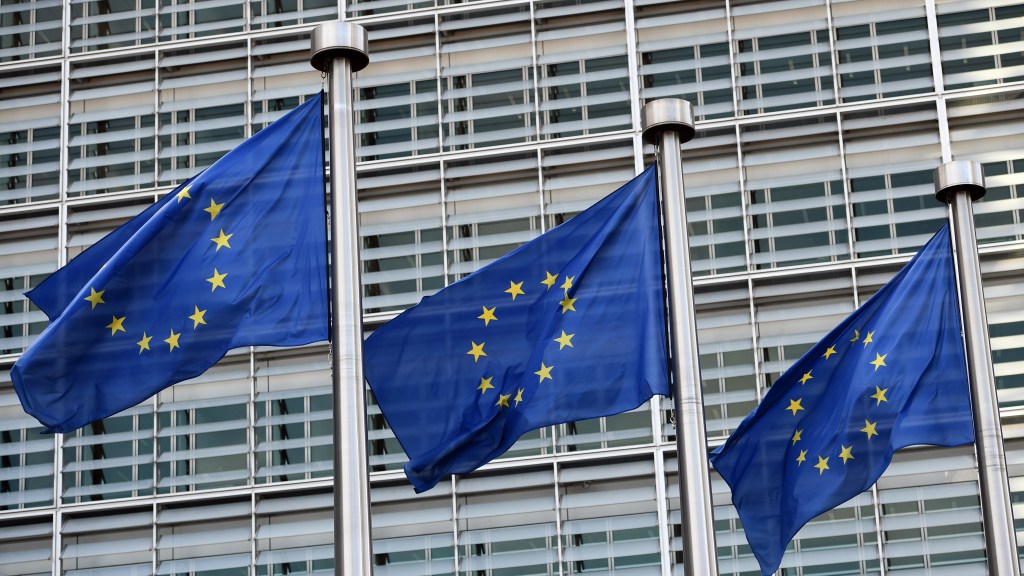
European Union flags hang outside the European Commission Headquarters on March 10, 2017 in Brussels, Belgium. (Photo by Carl Court/Getty Images)

The EU is widely recognised as the pre-eminent regional organisation. It’s level of success and continuity is unparalleled by other regional bodies, which are slowly trying to catch up with the European powerhouse. For some organisations, the EU has provided a model of development which has been followed to a large extent, allowing for real integration to take place, such as in the African Union. However it is hardly a surprise that a lot of differing regional organisations have not used the EU model as one to follow, with most states heavily rejecting the EU’s supranationalism and impedance on a states own sovereignty. Economic integration is where other regional bodies have followed the EU as far as they dare, but politically and militarily other states have rarely been as forthright; therefore the EU model has only been followed so far as its economic benefits outweigh the bureaucracy that comes with it.

Economically, the EU’s model for success is loosely followed by most rival regional bodies. Some such as the South American Mercosur, have heavily implemented the EU regional model for economic success. Mercosur has created a full blown customs union between nearly all South American nations with the likes of Argentina and Brazil being fully fledged members, and other states such as Chile and Colombia being associate members (who still receive the benefits of tariff-less trade). The customs union like the EU’s own, allows for free intra-zone trade, has devised a common trade policy and applies a common external tariff on the import of non-Mercosur goods. The creation of the customs union has led to Mercosur trade being worth $3 trillion a year, with the IMF noting it as the 5th largest trade bloc economy in the world. Along with economic integration, Mercosur introduced a Common Market Council and a Common Market Group, which design the nature of Mercosur trade and oversee its implementation across sectors; much like the EU council of Ministers, and in part like the directorate-generals of the EU commission. Therefore it can be seen that the model of economic integration shown in the EU is largely adopted, and has shown much success in improving economic conditions.

Yet, the EU’s model has not been truly replicated in any regional organisations, with some saying that the EU model would not be appropriate. This is the case in south-east Asia, where ASEAN has rejected the EU model despite wanting to achieve broadly the same aims. On the surface, the creation of a single market within ASEAN and desires for a single currency seem in line with the development of the EU, yet ASEAN rejects the creation of a fiscal union or that of a pseudo political one, which infringes on the sovereignty of its members. The four freedoms present in the EU, are restricted in ASEAN, with a key stipulation being the free movement of skilled labour – not people. Furthermore, those inside ASEAN see the EU path and ASEAN being distinctly different and so require a different approach; ASEAN encompasses a landmass that is more water than land, which presents different challenges to trade than that of the single landmass which allows the EU to develop such frictionless trade. Additionally, the cultural divides and rivalries are much more evident in south-east Asia, according to Asian Investment Bank vice-President Stephen Groff who sees these issues as key reasons why “…it’s not an appropriate model and nor should it be an objective of the ASEAN countries to achieve the same level of integration that you see in Europe.” Therefore it can clearly been seen that some regional bodies such as ASEAN, reject the EU model as it cannot be universally applied and be expected to create the same outcome. For a lot of regional organisations, development of their own institutions and level of integration is a strictly personal task. In light of this, the EU model is a good success story, but cannot be wholly applied in other regional bodies economically, simply due to the supranational element, which requires a huge sacrifice of sovereignty before the fruits of their labour show. Therefore the EU model can be seen to be applied in other regional organisations to a limited extent.

Politically, this issue is even more pronounced as many members of regional bodies heavily reject the idea of losing real sovereignty to a higher power. However this is not the case within the African Union, which to a large extent has replicated the institutions of the EU, with states accepting outside jurisdiction in some areas. The African Union has progressed in the same way as the EU, developing as a body through the treaties of Abuja (1991) and Sirte (1999), which created many of the institutions that are representative of the EU. These established a Pan-African Parliament, which includes 265 elected representatives of the 55 member states, that debate African issues. Furthermore it created the Assembly of the African Union, where heads of state meet annually as well as a Commission, an Executive Council and a Court of Justice which rules on interpretations of AU treaties. These bodies are all modelled from the EU’s own institutional setup to try and further African integration and allow for economic ties to become tighter. Yet even whilst replicating the EU model, much reform is needed within the African Union to make its institutions truly effective. However, even the African Union has rejected full blown supranationalism, with the Court of Justice having no power over domestic affairs of the Unions members. Therefore it can be seen that the EU has been directly used as a model for integration in other bodies, but there is still a way to go before it is truly emulated in a different regional body.

For the vast majority of regional bodies, the EU’s level of political integration is too deep for other states to pallet, with most adhering to an intergovernmental structure to retain sovereignty. This is the case within the Arab League, who place the independence of its members above all else. The Arab League primarily focuses on defusing tensions and creating relationships between states and representing Arab issues. Councils meet to discuss different sectors such as transport and vote on decisions, with decisions only being binding to those that vote for them. There is no resemblance or desire to resemble the EU here, where many heads of state want to keep external influences at a minimum. Many leaders in the Arab League fear that the Arab nationalist sentiment may lead to a sharing of wealth on this basis between the richer and poorer majority Arab nations, which would be detrimental to some wealthier Arab states. Therefore it can be seen in some extreme cases that the EU model is rejected entirely, with its achievements being directly opposite to the goals of other regional bodies. Therefore the extent of the EU as a widely accepted model of political integration is limited.

Finally, in terms of security integration, the EU’s continued insistence on a common security and foreign policy has been followed to an even lesser extent by other regional bodies who continue to reject the supranational factor. The treaty of Lisbon which created the common and security policy, is much of the reason why the EU has not been used as a model for others; because it shows that for real security integration to work, political integration is a necessity. However some elements of the make-up of EU security are utilised, by others such as the Arab League. The League has created a joint peacekeeping force, which acts in a similar fashion to the EU peacekeeping force, being deployed in areas such as South Lebanon, Darfur and Somalia. This is somewhat following part of the EU model, but displays that the EU has not been widely viewed as a good example for security integration.

In opposition to the EU’s supranational structure, bodies like the Shanghai Cooperation Organisation have based security integration on bilateral co-operation. The organisation takes a joint approach to military training, planning and information sharing to tackle terrorism and extremism. SCO have developed their depth of integration through the creation of the Regional Antiterrorism Structure in 2004, which has since foiled over 600 terrorist plots and extradited 500 terrorists. However the organisation rejects any form of common policy towards security, and mostly rely on cross-boarder co-operation to operate. This is especially the case when Russia and China are its two most prominent members, who arguably already have the ability to protect their borders without entering into a regional structure. Therefore it can be seen that the EU’s security and military integration has been widely rejected, with most security-based regional bodies only willing to collaborate, not enter into real integration with one another. Therefore it can be said that the EU model concerning security has been ignored to a large extent by other bodies.

In conclusion, it can be seen that the EU has provided a base model for other regional organisations to look to for inspiration and display a successful regional body. However in practice the EU’s model has been underutilised politically, economically and militarily due to one single factor that runs through all of them; supranationalism. Although new regional bodies see the success that can arise from pooling their sovereignty, they are unwilling to give this up for fear of being subject to the jurisdiction of a body which may not always rule in their favour. Therefore the EU model can be seen to be used to a small extent, with it being most utilised economically, where states are far more willing to begin to open its borders to freer trade and so catch up with the pre-eminent economies of the world, most notably the EU. Yet the EU is a unique case, where historical events necessitated the creation of a regional body to heal the wounds of a divided Europe, which is not the case for many other regional bodies; explaining why it cannot always be universally applied.